
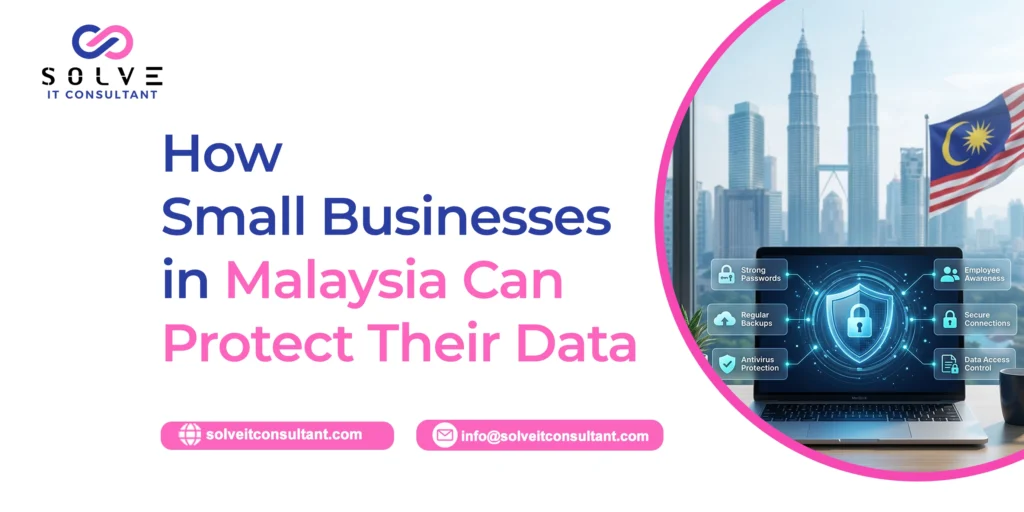
Cyberattacks aren’t just something that happens only to huge corporations. In Malaysia, small and medium-sized enterprises (SMEs) are seen as more attractive targets because they regularly manage valuable customer information, financial records, employee data, and day-to-day business files, yet they usually have less cybersecurity support and staff than larger organizations. One successful attack can then cause financial loss, work stoppages, a damaged reputation, and basically a loss of customer confidence pretty quickly.
So for Malaysian SMEs, safeguarding business data should really be treated like a core element of business management, not just an optional “IT expense.” Starting from better passwords and multi-factor authentication, all the way to protecting cloud environments, guiding training for employees, and keeping dependable backups, companies can still take real-world steps to reduce how exposed they are to cyber threats. This guide breaks down ways Malaysian SMEs can tighten their data security and create a tougher, more resilient setup.
Why Malaysian SMEs Are Becoming Targets for Cyberattacks
Malaysian SMEs are depending on digital systems for routine operations more and more, like cloud applications, online payments, e-commerce platforms, email communication, accounting software, and customer relationship management tools. Sure, these tools raise productivity, but they also add many additional entry points that cybercriminals can use.
Attackers often search for organisations that have weaker security safeguards, because it can be less complicated to break in. An SME does not automatically need millions in revenue to become a target. Things like customer lists, employee login credentials, financial details, intellectual property, and even access to larger business partners can be highly valuable to attackers.
Cybersecurity incidents can come with those kinds of indirect costs too. If systems go down or just become unavailable, employees may not be able to do their jobs, customers may not reach the services they need, and normal day-to-day business operations can slow down quite a bit. For a small business that is running on limited resources, even a brief period of disruption can end up hitting much harder than people expect. Check out our latest blog post on Best Managed IT Services for Small Businesses in the USA.
Understand what data your business holds
The first step toward protecting business data is basically figuring out what information the organization keeps and where it actually sits. A lot of SMEs run on a mix of laptops, office computers, cloud platforms, email accounts, external drives, mobile devices, and those third-party applications.
Businesses should pinpoint sensitive data like customer details, payment information, employee records, contracts, passwords, financial documents, and intellectual property. After that, the business can map out who should be allowed to see or handle it, plus what safeguards should be used.
Also, it’s important to revisit third-party applications and cloud services on a regular basis. Old accounts, unused software, and unnecessary access permissions tend to form security gaps. Removing accounts and permissions that are no longer required can really shrink the potential attack surface in a practical way.
Use strong passwords and multi-factor authentication
Weak or reused passwords are still one of the easiest routes for attackers to get into business accounts. Employees sometimes use related passwords across multiple platforms, so once one password gets compromised, it can potentially expose several systems at the same time.
Then there’s multi-factor authentication (MFA), which adds yet another protective layer. Even if someone manages to grab or guess a password, MFA can make it meaningfully harder for them to actually break into the account. SMEs must enable MFA wherever providers offer it—especially for email, cloud storage, financial platforms, administrator accounts, and other critical services.
Train Employees to Recognise Cyber Threats
Staff is an important ingredient in an organization’s overall cybersecurity plan. A lot of cyberattacks start with social engineering, like phishing emails, bogus login pages, malicious attachments, or scammy messages meant to coax employees into handing over information they shouldn’t.
Ongoing cybersecurity awareness training helps employees spot suspicious messages before they turn into security incidents. The training should include typical red flags, for example, odd sender addresses, urgent payment requests, unexpected attachments, sketchy links, plus anything that tries to get passwords or confidential data
Companies also need to keep it simple when it comes to reporting suspicious activity. Employees should know who to reach right away if they click a questionable link, download something they didn’t expect, or think their account might be compromised. A fast internal response sometimes stops a small problem from evolving into a huge breach
A Practical Cybersecurity Checklist for Malaysian SMEs
A strong cybersecurity program doesn’t really need to start with pricey tech right away. SMEs can begin by forming a workable baseline of security controls, something grounded and steady, not too complicated.
Start with these key moves, sort of essential stuff:
– Identify sensitive business and customer data.
– Use strong and unique passwords
– Enable multi-factor authentication
– Train employees to spot phishing and social engineering
– Keep operating systems and applications updated
– Maintain regular and secure backups
– Encrypt sensitive information and devices
– Restrict access based on job responsibilities
– Secure remote and cloud access
– Install dependable endpoint security
– Monitor important systems and accounts
– Create and test an incident response plan
– Review cybersecurity controls regularly
– Keep data protection policies and procedures updated
Why Cybersecurity Should Be a Business Investment
For Malaysian SMEs, cybersecurity shouldn’t be treated only as an IT bill. When you protect data, you’re also protecting revenue, customer ties, employee details, daily business operations, and the reputation a company has spent time building.
A proactive approach is generally better than waiting, then reacting after a breach occurs. Companies that catch risks early, harden their systems, train staff, and prepare recovery processes tend to respond faster and with less chaos when threats show up
Cybersecurity can also support growth. Customers and business partners increasingly expect organizations to manage information responsibly and to keep sensible security practices in place. A business that shows consistent data protection can build greater trust, and that trust often matters more than people think.
In conclusion,
Cyberattacks can really hit Malaysian SMEs hard, including financial loss, downtime, and reputational damage, but it is not like a business must have unlimited budgets or huge cybersecurity departments to get better security. Contact us as Instead, a mix of practical measures like strong passphrases, MFA, employee awareness, regular software upgrades, secure backups, careful access controls, encryption, endpoint protection, and an incident response plan can build a solid base for protecting data.
Probably the biggest step is to begin before something bad happens. If Malaysian SMEs keep checking risks and steadily tuning their security controls, they can lower exposure, safeguard sensitive information, and keep business continuity, even when the digital landscape keeps shifting around them.
Cybersecurity is more like an ongoing duty rather than a one-time project. With the right people, the right routines, and suitable technology, Malaysian SMEs can form a safer online environment and also strengthen trust with customers, staff members, and partners, all at once.