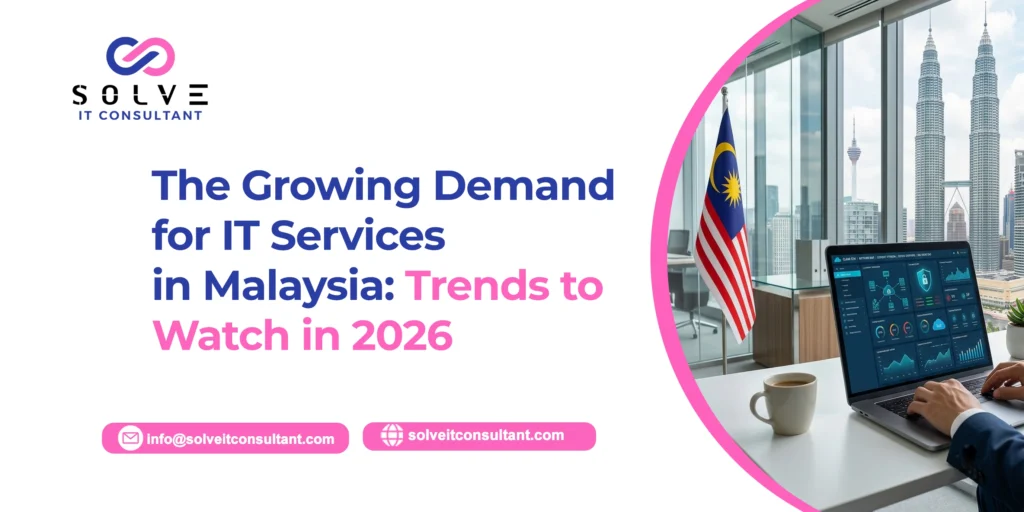
Malaysia has kind of emerged as one of Southeast Asia’s quickest-growing digital economies, so it feels like a very tempting place for companies looking for new ways to deploy technology. From little startups to massive multinational firms, organizations are putting more money into digital transformation lately, trying to boost efficiency, make customer interactions feel better, and stay sharp in a market that keeps changing really fast. As more industries start using automation, artificial intelligence, cloud computing, and analytics-based decision-making, the need for dependable IT services keeps climbing at a pace that almost sounds unreal.
By 2026, Malaysia’s IT sector should expand even further, because government initiatives, broader digital take-up, and cybersecurity issues are quietly but steadily changing how businesses run day to day. Many companies aren’t treating IT like it’s just a back-office support thing anymore. They’re instead seeing technology as a strategic investment that backs up sustainable growth. If organizations pay attention to these signals and shift patterns, they can make better choices and get ready for whatever comes next.
Why Malaysia’s IT Industry Is Growing Rapidly
Malaysia has positioned itself as a regional technology base through real investment in digital infrastructure, innovation, and smart technologies. Government programs that nudge digital adoption among SMEs, together with higher foreign investment, have sped up the country’s technological progress. You can see this in manufacturing, healthcare, retail, finance, logistics, and education too, where organizations adopt modern IT tools to remain competitive in both regional and overseas markets.
Another big thing that keeps pushing growth is rising pressure around digital customer experiences. People now expect quicker services, safe online transactions, more personal interactions, and just smooth communication across different channels all at once. So to stay on track, companies are putting money into upgraded IT infrastructure, software engineering, cloud platforms, cybersecurity protections, and managed IT services, which basically helps them run more efficiently while also trimming long-term expenses.
-
Cloud Computing Will Keep Dominating Business Operations
Cloud technology has sort of become the foundation layer for modern business infrastructure. It lets organizations keep data in a safer way, run applications remotely, and scale computing power based on what’s really happening in the business. By 2026, more Malaysian businesses are expected to move away from traditional on-premise setups and shift to cloud-based platforms, because it’s usually simpler and less expensive for them. Also, it gives better flexibility.
Cloud adoption also supports remote work, disaster recovery, and general business continuity. Companies can launch new applications faster, coordinate tasks across multiple locations, and make sure staff get secure access to business systems from wherever they are. Managed cloud services will keep growing too, since many organizations don’t want to deal with the whole thing alone—migration, performance tuning, day-to-day maintenance, and security monitoring are often handled by specialists.
-
Cybersecurity Will Climb to the Top Business Priority
As businesses become more and more digital, cyber threats keep growing in complexity and also in frequency. Ransomware attacks, phishing scams, insider threats, and data breaches have basically made cybersecurity one of the biggest concerns for Malaysian organizations. Keeping sensitive customer information safe and staying compliant with regulatory rules is now a must-have business requirement, not just a “nice to have.”
In 2026, businesses will likely spend quite a lot on cybersecurity services like threat monitoring, endpoint protection, network security, vulnerability assessments, penetration testing, and security awareness training. Companies are also leaning into Zero Trust security models, plus AI-driven threat detection systems, to spot and respond to cyber risks earlier before the damage gets big.
-
Artificial Intelligence Will Transform Business Operations
Artificial intelligence, or AI, is changing how businesses operate by automating repetitive tasks, strengthening customer service, and giving useful business insights through deeper data analysis. In Malaysia, companies are integrating AI into customer support, marketing, finance, healthcare, logistics, and manufacturing. Not only that, but they are doing it in a pretty practical way, like fewer manual steps, more visibility, and faster decisions.
AI-powered chatbots, predictive analytics, recommendation engines , and “smart” automation solutions help reduce operational costs while also lifting productivity and customer satisfaction. As AI tech becomes easier to access in 2026, organizations of almost all sizes will rely on IT service providers to implement tailored AI solutions, adjusted to their own business goals.
-
Managed IT Services Will Become Essential
A lot of businesses are starting to realize that running an in-house IT department can be costly in a very “not worth it” kind of way, and it also feels resource intensive. Bringing in skilled people, managing the infrastructure, making sure security is solid, and keeping systems running the whole time means a lot of ongoing work and money. So it shouldn’t be surprising that managed IT services are turning into a pretty appealing alternative.
With managed service providers, you get proactive monitoring, technical assistance, regular software upgrades, infrastructure oversight, backup services, plus cybersecurity coverage, all under predictable monthly pricing. That basically lets the business concentrate on its core operations, while experienced IT specialists make sure everything stays secure, refreshed, and fully operational 24/7, not just “when something breaks.”
-
Digital transformation will accelerate across industries.
Digital transformation isn’t only for big companies anymore. In Malaysia, many small and medium-sized businesses are jumping into digital tools to boost productivity, simplify daily processes, and give customers a better experience. You can see it across retail, healthcare, logistics, education, banking, and manufacturing, where organizations are investing in automation and more intelligent software over time.
They’re rolling out Enterprise Resource Planning, also known as ERP, Customer Relationship Management (CRM), workflow automation, digital payments, and cloud teamwork platforms. IT service providers end up being a key part of the whole effort—planning, deploying, connecting systems, and continuing the maintenance—so the business doesn’t stumble during the transformation phase.
-
Software Development Will Shift Toward Custom Solutions
Since every company has its own operational quirks, a generic app can sometimes feel like a mismatch even if it looks decent on paper. As competition tightens, teams want tailored applications built for their exact needs rather than one-size-fits-all software. And that means… they’ll be looking more often for bespoke development, integration, and ongoing support designed around real workflows, not theoretical ones.
Custom software development lets companies boost efficiency, automate those manual chores, connect several business systems, and also craft more personalized customer interactions. By 2026, the need for web applications, mobile apps, enterprise software, SaaS platforms, and API integrations is likely to keep climbing because businesses are actively looking for scalable digital solutions that can still support future growth too.
-
Data analytics will drive better business decisions
Most companies generate huge piles of data each day, from customer interactions, sales transactions, websites, mobile applications, and even internal operations. Still, just collecting information is not really enough. Organizations need smarter analytics tools to turn raw details into something you can actually act on, instead of just having numbers sitting around.
With data analytics, businesses can spot customer patterns, forecast market direction, optimize inventory levels, improve operational flow, and uncover fresh revenue ideas. On top of that, IT service providers are more and more delivering business intelligence solutions, dashboard development, and data visualization tools that help organizations decide faster, using up-to-the-minute insights rather than assumptions.
-
Internet of Things (IoT) Adoption Will Expand
The Internet of Things (IoT) is getting more and more important in Malaysia, especially across manufacturing, logistics, healthcare, agriculture, and those smart city initiatives. Basically, connected devices collect and then swap real-time information, and that helps a lot with operational efficiency; it also supports predictive maintenance, which is kind of a big deal for reducing unexpected downtime.
More and more businesses are leaning on IoT sensors to keep an eye on equipment performance, follow inventory movement, manage energy consumption, and streamline production workflows. As IoT adoption keeps growing during 2026, organizations will need specialized IT services to handle device connectivity, strengthen network security, complete cloud integration, and manage massive-scale data processing.
-
Remote and Hybrid Work Will Continue Driving IT Investments
Even if many employees have already come back to offices, hybrid work is still staying as a long-term business model for quite a few organizations. Companies still have to make sure secure access to corporate systems is in place while keeping productivity steady across distributed teams, no matter the time zone.
Because of this, the demand is rising for virtual desktops, cloud-based collaboration tools, secure VPN setups, identity management systems, endpoint protection solutions, and unified communication platforms. IT service providers tend to implement secure remote work environments that support teamwork without sacrificing data security or operational efficiency.
-
IT Talent Shortages Will Increase Outsourcing Demand
The fast expansion of digital technologies has actually caused a kind of shortage of skilled IT professionals in Malaysia, and it feels like the gap is getting bigger month after month. At this point, finding qualified experts in cloud computing, cybersecurity, AI software development, DevOps, and data science has become harder for a lot of organizations, not just the small ones.
So instead of spending months chasing specialized talent and trying to “win” candidates, many businesses are outsourcing IT projects and ongoing technology management to more experienced service providers. In a way, this lets organizations get certified professionals faster, cut down on hiring expenses, push project delivery ahead, and just stay focused on the bigger business priorities, you know, the strategic parts.
How Businesses Can Prepare for 2026
To stay competitive, businesses should look at their current IT infrastructure first and then spot where modernization is really needed. Putting money into cloud solutions, cybersecurity, automation, AI, and managed IT services can strengthen operational resilience and support upcoming growth. Also, organizations need to not ignore employee training, data governance, and the whole strategic technology planning part; otherwise, the return on IT spending might not be as strong.
Working with a trusted IT service provider helps businesses roll out these technologies in a smoother way while cutting down on the headaches that come with implementation risks. With the right support and expert direction, organizations can shape digital environments that are scalable, secure, and also ready for whatever comes next. The idea is that you’re not just “installing tools,” you’re building a setup that can keep up with shifting market needs, and yes, even new customer expectations.
Conclusion
In Malaysia, the demand for IT services is expected to keep rising across 2026, mainly because companies are pushing harder on digital transformation. Contact us as At the same time, they’re strengthening cybersecurity, leaning into cloud technologies, and exploring artificial intelligence. For many industries, technology is no longer only an operational requirement; it is the engine of innovation and efficiency.
Investing in modern IT solutions now should help businesses compete later. Whether managed IT services, cloud migration, cybersecurity, custom software development, or AI implementation, partnering with experienced IT pros keeps you agile, protected, and prepared for 2026.