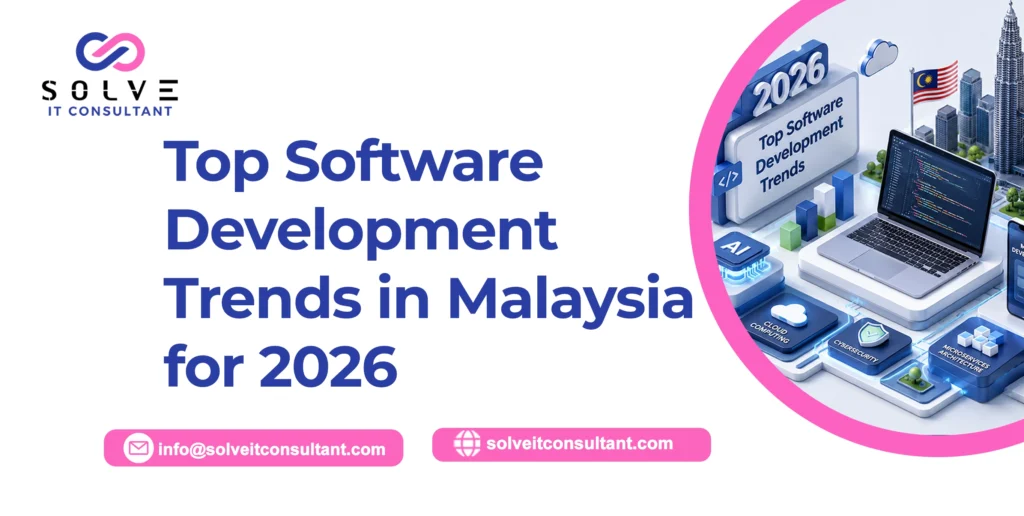
Malaysia’s software development industry is moving into a more intelligent and competitive phase in 2026. Businesses aren’t just putting money into technology so they can get a basic website or an app. Instead, they’re going for AI-powered systems, cloud-native applications, automated workflows, better cybersecurity, and digital platforms that are designed to scale and keep up with long-term growth.
At the same time, Malaysia’s broader digital ecosystem is helping this shift along. The National AI Office has rolled out the National AI Action Plan 2026–2030, and government initiatives are still pushing hard on AI adoption, governance, talent, cloud infrastructure, and digital innovation. Because of that, the environment is opening up bigger chances for software firms, developers, and startups, as well as enterprises.
For Malaysian businesses, this matters because software expectations are changing very fast. Now, software must be quicker to build, simpler to scale, stronger on security, and more and more capable of using data and artificial intelligence to improve business decisions. It’s less about “Can we ship it?” and more about “Can we run it safely, reliably, and smarter?”
Why Software Development Is Changing Rapidly in Malaysia
Software development in Malaysia is getting more tightly tangled with the national digital transformation goals, you know, the whole push toward modern tech. MDEC has said there is continued growth in digital spending and that AI, big data, data centers, and cloud services are playing a major role in how the country is expanding its technology. That, in turn, creates a better and more ready environment for companies trying to build advanced digital products and services.
Also, the launch of Malaysia’s National Cloud Computing Policy kind of makes it clear that secure, inclusive, sovereign, and sustainable cloud infrastructure is becoming more important. As more organizations shift their systems and data into cloud environments, software developers will be expected to design applications that are cloud-ready from the start, not as an afterthought.
At the same time, businesses are under more pressure to get things done with higher efficiency. Companies want development teams to ship faster while still keeping security solid, performance stable, and reliability intact. This is one of the big reasons why AI-assisted development, automation, DevOps, and low-code platforms are becoming more relevant day by day.
1. AI-Powered Software Development Will Become Mainstream
AI-powered development is expected to turn into one of the key software development trends in Malaysia in 2026. Developers are already leaning into generative AI tools for help with code generation, debugging, documentation, testing, and even ongoing software maintenance.
Still, the biggest shift might not be just “faster writing code.” AI is slowly becoming part of the entire software development lifecycle. In practice, development teams can use AI to analyze requirements, spot likely bugs early, generate test cases, review code, and also automate repetitive tasks that would otherwise waste time.
Why it matters:
AI can help development teams spend less time on repetitive tasks and more time on the complex business stuff. For Malaysian software companies, this can lift productivity and also make dev cycles shorter, but only if AI tools are used with proper human review, because well… nobody wants silent errors.
The key thing is AI won’t remove the need for skilled developers. Instead, developers will be pushed to learn AI integration, prompt engineering, system architecture, model governance, security, and quality assurance, kind of like a new layer of responsibility on top of the normal work.
2. Agentic AI and AI-integrated applications will grow
The next phase of AI adoption goes past chatbots and basic content generation. By 2026, more businesses are expected to try AI agents that can do multi-step work, talk to business systems, and back up automated workflows.
For example, an AI-enabled customer service platform could analyze a customer’s request, then look for internal information, update a CRM system, and finally draft a response. In the same way, AI agents may help with internal IT operations, finance processes, HR workflows, and even software testing.
That trend will raise the demand for developers who can connect AI models with APIs, databases, enterprise software, and security controls. The real challenge, though, is making AI systems that are actually useful without giving them unnecessary access to sensitive systems or data, because “just in case” access is rarely a good idea.
Why it matters
Businesses in Malaysia will increasingly want software solutions that do more than just store information. They’ll want applications that assist people, automate decisions, and complete routine tasks.
For development companies, this suggests AI integration could end up being a default feature in enterprise projects, not some separate experimental add-on.
3. Cloud-Native Development Will Accelerate
Cloud-native software development will keep expanding as Malaysian businesses modernize their infrastructure. Instead of creating applications that rely on one traditional server setup, companies are moving more often toward architectures that are made to run across scalable cloud environments in a smoother way.
In practice, cloud-native development usually touches containers, microservices, APIs, serverless computing, and automated delivery pipelines; it’s kind of a bundle. With these choices, organizations can scale just one section of an application without rewriting the whole system from scratch.
Malaysia’s National Cloud Computing Policy, launched in 2025, is meant to help build a secure, inclusive, sovereign, and sustainable cloud ecosystem. This direction underlines why cloud capabilities matter so much for businesses and software providers as they head into 2026.
Why It Matters
Cloud-native applications can bring more flexibility and become containerization, allowing companies to adjust as their customer base shifts or operational needs grow. At the same time, businesses can boost system uptime and also cut down on dependence on inflexible infrastructure.
So developers will need firmer know-how around cloud platforms, containerization, infrastructure automation, application observability, and cloud security.
4. DevSecOps Will Replace Security as an Afterthought
Security is turning into an integral part of the software development process, not something tucked in at the end once an application is basically done. This method, sometimes described as DevSecOps, links security testing and continuous monitoring throughout development as well as deployment.
The way organizations are leaning into cloud services, connected apps, APIs, and third-party platforms really does expand the potential attack surface in a kind of domino effect. But then again, AI-generated code plus automated development can also bring in extra governance and quality headaches if teams end up releasing software without a solid review.
In Malaysia, things are getting more complicated too. Companies are depending more on cloud platforms, data ecosystems, and interconnected technologies, so keeping security and resilience going continuously is becoming something software development teams have to treat as normal, not optional.
Why DevSecOps Will Replace Security as an Afterthought
Generally, it is easier to fix a security problem while you’re still in early development rather than later, after a system has already been shipped. DevSecOps pushes teams to weave in code scanning, vulnerability testing, access controls, and security review steps all the way through the lifecycle.
By 2026, businesses will want software providers to show not just what their applications can do. They’ll also want proof of how the provider protects data, end users, and daily business operations.
5. Low-Code and No-Code Development Will Support Faster Innovation
Low-code and no-code platforms are turning into practical tools for firms that need to build internal applications, workflows, dashboards, and quick prototypes without too much friction. These platforms can cut down the need for manual coding in certain kinds of work, which sounds simple but saves time.
In Malaysia, this can be especially helpful for SMEs that want to digitize operations without holding on to a big in-house development team. And when visual development tools are there, business users can take part in app design more directly, almost like a shared craft instead of a handoff. Check out our latest blog post on Why Digital Transformation Is Essential for Malaysian SMEs in 2026
How Malaysian Businesses Can prepare for these trends
First, maybe take a look at what you already have. Assess your existing software, especially the parts that feel older, like outdated apps or those manual processes that keep slowing people down. Also check for security weaknesses and spots where systems don’t really talk to each other properly. Once you do this kind of inventory, you can usually see where modernization can actually bring business value, not just “nice to have” changes.
Build an AI and data strategy, but do it in a grounded way. Figure out where AI can genuinely improve daily operations, customer service, reporting, and similar stuff. At the same time, make sure the data infrastructure is ready enough, because without it, AI becomes more theory than reality. Governance and responsible use should be part of the plan from day one, not something you tack on later.
Invest in cloud and security skills. Teams will need stronger know-how in cloud platforms, cybersecurity, DevSecOps, APIs, automation, and then AI integration again. Upskilling existing employees can be just as important as hiring new specialists, because you’re building internal momentum, and that usually matters.
Modernize in phases. Don’t try to replace everything in one big push. Start with high-impact applications, do pilot projects first, and let organizations test the new tech in smaller ways before you commit to larger investments.
Choose technology partners carefully. A software development partner should understand business goals, as well as technical requirements. Companies should look for expertise in security, scalability, cloud architecture, and long-term software maintenance. If they can’t explain the “why” behind their approach, that’s a red flag.
Frequently Asked Questions
1. What is the biggest software development trend in Malaysia for 2026?
AI-powered software development is likely one of the most influential trends. Malaysia’s national AI initiatives, plus growing business investment in AI, data, and digital infrastructure, mean AI integration is getting more important fast, not later.
2. Is cloud computing important for Malaysian businesses?
Yes. Cloud computing is turning into one of the most central pieces of Malaysia’s digital transformation strategy, and it’s backed by the National Cloud Computing Policy, plus the ongoing push for investment in cloud and digital infrastructure, overall.
3. Will AI replace software developers?
Maybe not exactly. AI is more apt to shift the role of developers than it is to simply replace them fully. Developers are still needed to design systems, double-check AI-generated code, handle the tricky stuff, manage security, and really grasp what the business is asking for and why.
4. What skills should software developers learn in 2026?
In 2026, developers should focus on boosting their ability in AI integration, cloud computing, DevSecOps, cybersecurity, APIs, data engineering, automation, and software architecture. Basically, it’s less about one skill only and more about mixing them well.
5. Are low-code platforms replacing traditional programming?
No, not in a straight line like that. Low-code platforms can be useful for specific tasks and certain workflows, but when you’re dealing with complex solutions, highly customized requirements, or large-scale software, you still need professional developers, plus traditional programming knowledge too.
6. Why is cybersecurity becoming more important in software development?
Because modern apps are rarely isolated anymore. They connect to cloud services, APIs, databases, AI platforms, and various third-party systems, so the ecosystem keeps expanding. That makes secure design, continuous monitoring, and security testing across the whole development cycle more important than before.
Conclusion
The top software development trends in Malaysia for 2026 point to a clear direction, toward intelligent, connected, cloud-based, and security-first technology. Contact us as AI will keep influencing how software is built and how applications behave in the wild, while cloud-native architecture, DevSecOps, data engineering, APIs, and automation continue to steer day-to-day development practices.