
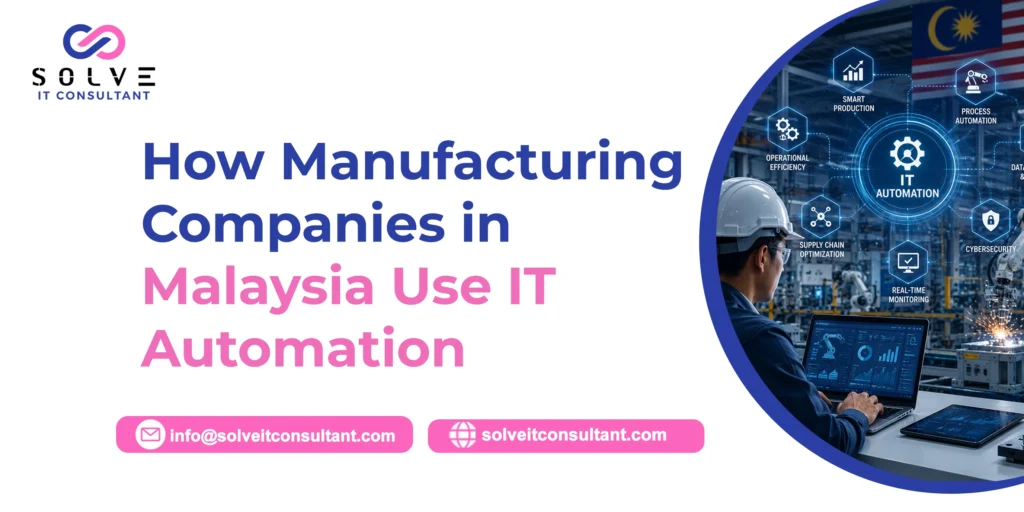
Manufacturing in Malaysia is moving pretty fast, as companies try to discover better ways to boost productivity, lower operating costs, manage labor challenges, and keep product quality more steady. IT automation is slowly becoming a major part of that whole shift; it kind of lets manufacturers connect machines, software, employees, and business workflows all together, like everything can communicate more easily in a practical sense.
Malaysia’s Industry 4.0 pathway is supported by initiatives such as Industry4WRD and the New Industrial Master Plan (NIMP) 2030. The Malaysian Investment Development Authority (MIDA) has also highlighted automation, artificial intelligence (AI), the Internet of Things (IoT), robotics, cloud computing, and data analytics as key technologies for smarter manufacturing.
What Is IT Automation in Manufacturing?
IT automation in manufacturing basically means using software, linked systems, data, and “smarter” technologies to manage routine jobs, monitor operations, and make business processes run more smoothly with less dependence on manual handling, day after day.
It can also connect production equipment with business applications, like Enterprise Resource Planning (ERP), Manufacturing Execution Systems (MES), inventory management platforms, and various reporting tools. This leads to a more connected environment where details move between the shop floor and the management side faster and often with fewer delays or awkward missing information.
For instance, instead of an employee writing down machine output every few hours, connected machines can automatically collect production data and push it into a central platform. Then managers can observe manufacturing performance, spot problems earlier, and make decisions using almost real-time insights, rather than waiting for someone to compile updates later.
For example, instead of an employee manually recording machine output every few hours, connected machines can automatically collect and push production data to a central system. Then managers can keep an eye on production performance, notice issues faster, and make choices using real-time information, without too much delay.
Why Are Malaysian Manufacturers Adopting IT Automation?
Malaysian manufacturers are adopting automation because the old-school manual processes can become a bit hard to manage as production volumes rise, customer expectations get tighter, and operational complexity goes up too.
MIDA mentions that automation can uplift production efficiency, bring down costs, increase output, and also help facilities switch between products more smoothly. Malaysia is aiming to transform 3,000 factories into smart factories by 2030 under NIMP 2030.
1. Automating Repetitive Production Tasks
One of the most typical uses of automation is dealing with repetitive tasks. Manufacturing firms can use robotic systems, automated machinery, and software-controlled equipment for things like assembly, packing, sorting, material handling, and machine tending.
Robots are able to repeat the same task again and again, with consistent accuracy and speed. That often leads to less human error, and employees end up having more time for supervision, upkeep, quality management, and other higher-value work because the repetitive part gets dealt with.
For instance, in Malaysia, robotics solutions are already in use for things like palletizing, welding, machine tending, assembly, and pick-and-place work, so it doesn’t feel that odd.
2. Using IoT for Real-Time Machine Monitoring
The Internet of Things basically helps manufacturing equipment collect and share data through connected sensors and tied-in systems.
So companies can install IoT sensors that watch machine performance, temperature, production rhythm, energy usage, and operating conditions. After that, the data can be displayed on dashboards, so managers can see what’s happening across the factory floor, instead of relying on assumptions.
This kind of real-time monitoring really matters, because problems can be detected earlier, rather than waiting for staff to notice them manually. MIDA has also pointed to IoT-connected machinery as an important piece of predictive maintenance and smart-factory evolution, sort of like an “early warning” setup but more networked.
3. Predictive Maintenance
When equipment fails, it may slow down production or just stop it altogether, and then you get those surprise repair costs too. IT automation helps manufacturers move from reactive maintenance into predictive maintenance, and that shift is pretty significant.
Since connected machines keep generating performance information continuously, analytics tools can review it and highlight odd patterns that might indicate trouble coming.
Maintenance teams can then check what’s going on before a serious breakdown shows up so that it doesn’t turn into a big thing. In the end this usually cuts down on those surprise stops; it also makes equipment available more often, and it lets companies schedule upkeep with a bit more sense, rather than guessing.
Check out our latest blog post on How Malaysian SMEs Can Protect Their Data from Cyberattacks
4. Automating Quality Control
Quality control is another place where automation can really shift things. Manufacturers can bring in cameras, sensors, AI, and machine-learning systems to inspect products for defects. Instead of depending fully on manual inspection, automated setups can evaluate items based on defined quality criteria.
AI-based inspection can spot abnormalities faster and more consistently, especially when you’re looking at high volumes of products that need to be examined at speed. MIDA has pointed out that AI-driven quality control and anomaly detection are key use cases within smart manufacturing.
5. Connecting ERP and Manufacturing Systems
IT automation isn’t only about factory machines, either. It also helps tie together different business systems.
For example, an ERP system can handle purchasing, inventory, orders, finance, and other business info, while an MES can share more detailed production data. When these systems are linked, companies can end up with less duplicate data entry and smoother information flow between different departments.
Once systems talk to each other, production teams can get more dependable details about orders and materials, and management can see operational performance with better clarity.
MIDA has stressed that integrated systems improve the flow of information and can reduce operating costs, particularly when manufacturers connect equipment and the business side properly.
Benefits of IT Automation for Manufacturing Companies in Malaysia
IT automation can bring a bunch of advantages, but honestly, it only works well when it is arranged the right way, you know, in line with what a company needs day-to-day inside the factory flow. When it is done correctly, the results usually start to appear across productivity, costs, and even how steady the final product turns out.
More Productivity:
Automated systems can handle repetitive tasks, over and over, in a predictable manner. Because of that, manufacturers can improve overall output efficiency without fully leaning on manual labor for every small detail.
Lower Operational Expenses
Automation typically cuts down the time staff spend on repeat work; it also trims manual data entry and may help keep unnecessary downtime under control. It can also limit certain production faults, and over time these shifts usually bring operational costs down.
Consistent Product Quality
Automated inspections and continuous process monitoring help companies maintain quality targets that stay consistent. When defects are caught early, it can stop entire batches from going off spec, and that matters a lot for both reputation and spending.
Less Downtime:
Real-time monitoring together with predictive maintenance lets maintenance teams notice trouble sooner. So the chance of sudden, unplanned interruptions to production drops quite a bit.
Clearer Visibility
With automated dashboards, managers can get production and operational information faster. That makes it easier to spot bottlenecks sooner, as well as understand overall factory performance, without so much guesswork.
Higher Workforce Productivity:
Automation does not always mean replacing people. In many cases, it removes the repetitive portions of the work, so employees can move toward more technical analysis, supervision, and troubleshooting duties instead.
Challenges of Implementing IT Automation
Even with the strong upside that automation brings, Malaysian manufacturers sometimes run into a few hurdles when they start adopting brand-new tech. Like, it sounds easy on paper, but in real life, there are gaps.
One big hurdle is the initial cost: equipment, software, integration, and cybersecurity, plus the kind of employee training that takes time and money. For smaller manufacturers, it can be really hard to switch an entire facility in one go, because the budget and resources just do not line up.
Then there is legacy infrastructure. Older machines and older software may not talk nicely with newer systems. This mismatch can slow projects down or force extra work. MIDA has also pointed out barriers like technical and financial limits, skills shortages, limited awareness, and unstandardized processes. All of these can affect how SMEs handle Industry 4.0 adoption.
On top of that, staff often need training not only to operate the systems, but also to manage them when things go wrong. So companies typically need to treat automation as, yes, a tech implementation, but also as a workforce development task, not just a one-time purchase.
How Companies Can Start With IT Automation
Manufacturers do not need to automate everything right away. In fact, a step-by-step approach is usually more realistic and less risky.
Step 1: Identify the Repetitive Processes
First, look for the workflows that keep repeating and that eat up a lot of staff time or that cause frequent errors. Think of tasks like data entry, inventory updates, quality inspections, reporting, and those repetitive production activities that never really end.
Step 2: Spot the biggest bottleneck
Now figure out where automation can deliver the most business value, not just “cool tech.” A company might get more by automating inventory management instead of jumping right into an expensive robotic production line, because the payoff tends to show up faster.
Step 3: Look at what’s already in place
Then, take a close look at what you already have, like machines, software, network setup, and the way data is handled. This kind of check helps you decide what can be connected right away and what actually has to be upgraded before integration becomes even possible.
Step 4: Start With a Pilot Project
You know, a small automation project helps the company test the whole idea first, before pushing it more broadly across the factory floors. In that pilot phase, businesses can track productivity, total costs, stoppage time/downtime, output quality, and even get employee feedback, which is honestly often overlooked.
Step 5: Train Employees
Then there is training, because employees need a clear picture of how the new systems work and how their daily responsibilities will shift. Through upskilling, organizations can make better use of their technology investments, not just install tools and hope for the best.
Step 6: Scale Successful Solutions
After the pilot project delivers numbers that look measurable and real, the company can expand automation step by step into other departments and additional processes. In other words, once it proves itself in one area, it’s easier to widen the scope.
The Future of IT Automation in Malaysia
Malaysia’s manufacturing sector is moving toward more connected and more data-driven production environments. The Industry4WRD policy was created to support digital transformation in manufacturing and related services; meanwhile, NIMP 2030 keeps stressing technology adoption and industrial upgrading.
In the future, manufacturing setups will probably blend robotics, artificial intelligence, IoT monitoring, cloud platforms, analytics, cybersecurity, and automated business systems together. The aim will not only be to automate one machine or task; it will be to build linked operations where production, stock control, upkeep, quality control, and business systems can collaborate.
And this change can also help Malaysian manufacturers compete in sectors where speed, quality, flexibility, and operational efficiency matter more every year.
Conclusion
IT automation is turning into a major piece of Malaysia’s manufacturing transformation. From robotic production and IoT monitoring to predictive maintenance, automated quality control, ERP integration, and AI-driven analytics, technology is helping manufacturers create smoother, more connected operations.
But for automation to really work, it takes more than just buying fresh technology. Contact us as Organizations actually have to sort out what operational struggles they have, pick fitting solution sets, connect and integrate the systems properly, train employees well, and keep an eye on the results as well.
For manufacturers in Malaysia, the path ahead in automation is not only about swapping out manual processes. Instead, it’s about building smarter factories where people, machines, software, and data start collaborating in a way that boosts productivity, improves quality, raises flexibility, and supports long-term competitiveness.